

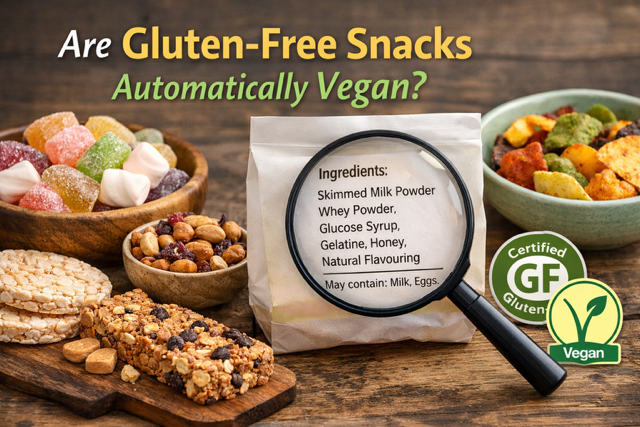
Many people assume gluten-free equals vegan because both sit in the “free-from” aisle and both are often chosen for wellbeing reasons. Add busy shopping, tiny print, and packaging that uses words like “plant-based”, and it’s easy to see why the question comes up so often: are gluten-free snacks vegan?
No, gluten-free does NOT automatically mean vegan. A snack can be labelled gluten-free because it meets the legal threshold for gluten, but still includes animal-derived ingredients like milk powder, whey, butter, egg, honey, or gelatine. In the UK, gluten is one of the 14 allergens that must be clearly highlighted in ingredients lists (helpful for gluten-free shoppers), but animal derived ingredients aren’t always as obvious unless you know what to look for. That’s why people ask “is gluten free vegan?” and “are gluten-free snacks vegan?” The labels can feel similar, but they’re not the same thing. The good news: with a few quick checks, you can confidently spot gluten-free vegan snacks in seconds.
“Gluten-free” (UK/EU)
In UK/EU labelling rules, “gluten-free” is a defined claim: foods labelled gluten-free must contain no more than 20 mg/kg (20ppm) of gluten. This is set out in the rules on gluten claims and reflected in UK guidance. For a practical explanation, Coeliac UK summarises the “20ppm” threshold and how the term can be used.
“Vegan”
“Vegan” generally means no animal derived ingredients (and, for many people, no animal exploitation). In the UK, vegan labelling is often supported by voluntary standards and trademarks. The Vegan Society’s Vegan Trademark, for example, checks products against criteria including no animal derived ingredients.
Bottom line: gluten-free is about gluten levels; vegan is about animal derived ingredients. Different checks, different risks.
Gluten-free recipes sometimes rely on ingredients that improve texture, richness, binding, or flavour and those can be animal derived. Here are the most common non-vegan gluten-free ingredients to watch for.
1) Dairy (very common)
Look out for:
It’s worth remembering: lactose gluten-free is totally possible, lactose is a milk sugar, not gluten, so lactose being present doesn’t affect gluten-free status, but it does affect whether the snack is vegan.
UK allergen rules help here: milk is one of the 14 allergens that must be emphasised in ingredients on prepacked foods. (FSA: Allergen labelling for consumers; GOV.UK ingredients list + allergens)
2) Egg (often in baked snacks)
Common forms include:
Egg is also a regulated allergen that must be highlighted, which makes it easier to spot quickly. (FSA allergen guidance)
3) Honey (often in “natural” snacks)
Honey turns up in snack bars, granola style bites, and some flavoured nuts. From a vegan perspective, honey is an animal product and is avoided by many vegans. (The Vegan Society: Honey industry; The Vegan Society: General FAQs on honey)
4) Gelatine (especially in sweets)
A big one: gelatine in sweets (plus marshmallows, gummy chews, jelly treats) is extremely common and it’s animal derived. You’ll usually see it plainly listed as “gelatine”, but some people miss it when scanning quickly.
5) Shellac/“confectioner’s glaze”
Some sweets, chocolates, and coated products use shiny glazes. Shellac (sometimes described as confectioner’s glaze) is insect derived and not vegan. Many vegan guidance lists flag shellac as an ingredient to avoid.
6) Carmine/cochineal colouring
Red/pink colouring can sometimes come from insects (often labelled carmine or cochineal, sometimes as E120). Again, it’s one of those hidden ingredients that can slip into otherwise “free-from” products. (The Vegan Society: ingredients to avoid list includes carmine/cochineal)
7) Fish derived ingredients (relevance note)
This is less common in everyday “gluten-free snacks”, but worth knowing in general label-reading. Fish is a regulated allergen in the UK, and fish derived processing aids like isinglass are more often discussed in drinks than snacks. If you ever see “fish” highlighted in a snack’s ingredients (rare, but possible in certain flavours), it’s obviously not vegan. (FSA allergen guidance)
1) Start with the ingredients list (10-second scan)
If you’re asking how to check if a snack is vegan, this is the fastest workflow:
2) Look for trusted vegan certifications
Because “vegan” can be communicated in different ways, a recognised vegan trademark can save time especially when you’re buying snacks for other people. The Vegan Society’s Vegan Trademark is one example of a standard that checks for animal derived ingredients.
3) Understand “may contain” statements (and what they don’t mean)
“May contain” style wording is precautionary allergen labelling, it’s about unintended cross-contact risk, not what the product is made from. The FSA notes that precautionary allergen labelling (PAL) like “may contain” should be based on an assessment of cross-contamination risk, and it can be used alongside vegan/vegetarian labelling.
4) The oats note (important for coeliac vegan snacks)
Oats are naturally gluten-free, but they’re often contaminated with wheat/barley/rye during growing or processing. Coeliac UK advises that only oats labelled gluten free should be eaten on a gluten-free diet.
Tick if YES:
If you’re ordering for a workplace, the challenge is rarely just “gluten-free vegan snacks” it’s the overlap of multiple needs: vegan, gluten-free/coeliac, nut-free preferences, halal considerations, and general “something for everyone”.
A simple approach for office managers/HR:
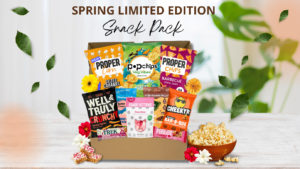
This is where curated providers can make life easier. For example, Snack Packs is a UK option that can help offices and busy households streamline the search by offering curated snack boxes where vegan and gluten-free choices are clearly selected and labelled useful when you’re ordering for a team and don’t have time to scrutinise every ingredient line.
If you’re trying to avoid label fatigue, it can help to lean on pre-checked variety. Snack Packs can be a practical shortcut for people who want coeliac vegan snacks and office friendly variety without turning every snack shop into a research project. It’s not about “perfect”, it’s about making safer choices easier on busy days, especially when you’re catering for mixed dietary needs.
So, are gluten-free snacks automatically vegan? No and the mix up is completely understandable. Gluten-free is about gluten levels; vegan is about avoiding animal derived ingredients. With a quick ingredients scan (milk/egg, gelatine, honey, shellac, carmine) and a simple oats check, you can choose gluten-free snacks vegan options with far more confidence.
Keep the checklist handy, and when you need an easy, office friendly mix that considers both dietary needs and practicality, options like Snack Packs can help you stay inclusive without making snack buying a full time job.
1) Is gluten-free the same as vegan?
No. Gluten-free relates to gluten content (and has specific rules around what can be labelled “gluten-free”). Vegan relates to avoiding animal derived ingredients, which can still appear in gluten-free foods. (Coeliac UK gluten-free law)
2) Are gluten-free snacks vegan?
Sometimes, but not always. Many gluten-free snacks contain dairy in gluten-free products (like milk powder or whey), eggs, honey, or gelatine. Always check the ingredients list.
3) What non vegan ingredients are common in gluten-free snacks?
Common non-vegan gluten-free ingredients include milk powder, whey, casein, butter/ghee, egg/albumen, honey, gelatine, shellac/confectioner’s glaze, and carmine/cochineal (E120). (The Vegan Society ingredients to avoid)
4) Are gluten-free sweets usually vegan?
Often no. Sweets are one of the most common places to find gelatine in sweets and shiny glazes like shellac. Some are vegan but it’s a “check first” category.
5) Are gluten-free crisps vegan?
Some are, some aren’t. Plain salted crisps are more likely to be vegan, but flavourings can include milk based ingredients (like whey or lactose). The allergen highlighting rules can make milk easier to spot quickly. (FSA allergen labelling)
6) Do “may contain milk” warnings mean it’s not vegan?
Not necessarily. “May contain” is a precautionary cross-contact warning, not a statement that milk is an ingredient. Some vegans avoid it, others don’t it’s a personal choice. (FSA precautionary allergen labelling)
7) Are oats gluten-free and vegan?
Oats are vegan, and they don’t contain gluten in the same way wheat/rye/barley do but they’re often contaminated with gluten. If you’re coeliac, choose oats labelled gluten free. (Coeliac UK oats guidance)
8) What does “gluten-free labelling UK” actually guarantee?
It indicates the product meets the legal threshold (20ppm or less) for using the “gluten-free” claim, rather than guaranteeing absolute zero gluten. (Coeliac UK: Gluten free and the law; FSA technical guidance)
9) How do I find gluten-free vegan snacks for an office?
Use a two-step approach: (1) filter for gluten-free, then (2) exclude non-vegan ingredients like milk/egg/gelatine/honey. For time saving variety, curated boxes (like Snack Packs) can help because selections are made with dietary needs in mind.
10) Is “plant-based” the same as vegan?
Not always. “Plant-based” is sometimes used loosely and may not follow a consistent standard. If you need certainty, check ingredients and look for a recognised vegan trademark where possible. (The Vegan Society: Vegan Trademark)
11) What’s the fastest way to check if a snack is vegan?
Use this order: scan allergens for milk/egg, scan for obvious terms (gelatine/honey), then scan for hidden ingredients (whey/casein/albumen/shellac/carmine). That’s the quickest how to check if a snack is vegan routine.
12) If something is gluten-free, is it automatically dairy-free?
No. Gluten-free and dairy-free are unrelated, dairy in gluten-free products is common (milk powder, whey, lactose), especially in baked or chocolatey snacks. Milk must be highlighted in the ingredients list, which helps you spot it. (FSA allergen labelling)
Gentle next step: Save the checklist and you’ll be able to answer “is gluten free vegan?” for most snacks in under 10 seconds and when you want easy, inclusive variety without overthinking it, Snack Packs is a handy UK option to keep on your radar.